
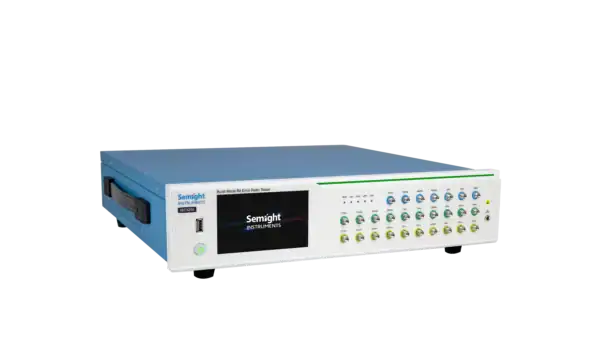
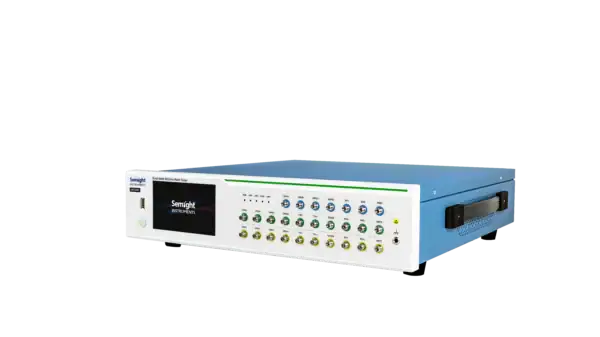
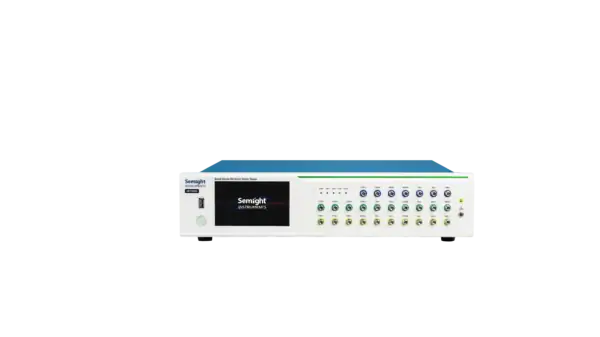
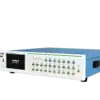
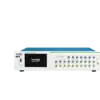
rBT3250
rBT3250
50G Burst Mode Bit Error Ratio Tester
Semight 50G Burst Mode Bit Error Ratio Tester rBT3250 is specifically designed for testing new burst error code analyzers for optical line terminals (OLTs) in next-generation 25G/50G passive optical network (PON) applications, used to evaluate the performance of 25G or 50G OLT receivers in burst mode.
Features

Multirate
GPON: 12.4416/
EPON: 25.78125/

Excellent Performance
Supports burst and continuous mode data signal output and error bits testing
The burst mode rate of 50 GBaud supports PAM4

Control Signal Matching
Provides 2 synchronous enable control signals for ONU laser: LVTTL 3.3V, configurable enable level
Provides 2 synchronous reset control signals for OLT: LVTTL 3.3V, configurable level, adjustable reset position and width

Rich Trigger Signal
Supports 1 RSSI Trigger signal: trigger mode, adjustable cycle, position, and pulse width
Supports 1 Trigger signal: position adjustable, used to assist in monitoring the length of burst data

High Efficiency
Quick configuration download and fast hardware response speed. Supports reset signal automatic positioning function

Fully Match ATE Application
With powerful and flexible database management capabilities
Functions and Advantages
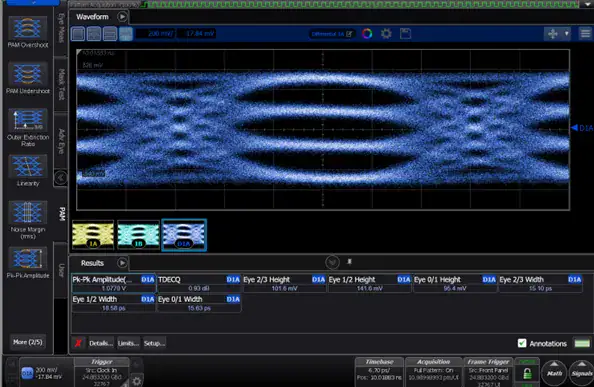
Burst Mode
Burst Mode supports 24.8832/25.78125 GBaud PAM4 testing.
Dual Package Testing
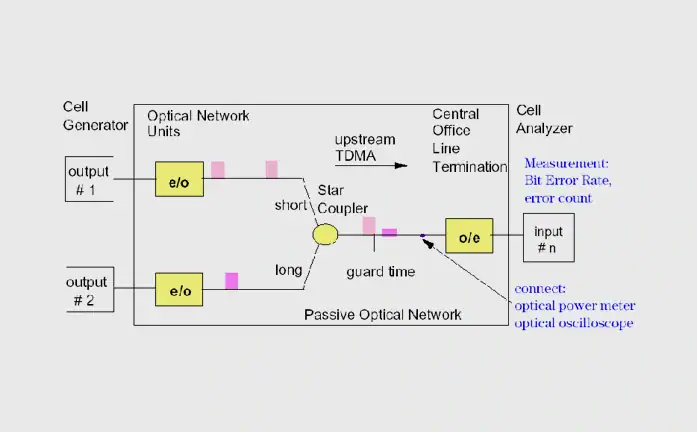
Each data packet has different attenuation, there is a phase jump between different data packets, and there are long connections of “1” and “0” in the data packets,
Need to simulate the generation of the worst 2 ONU signals;
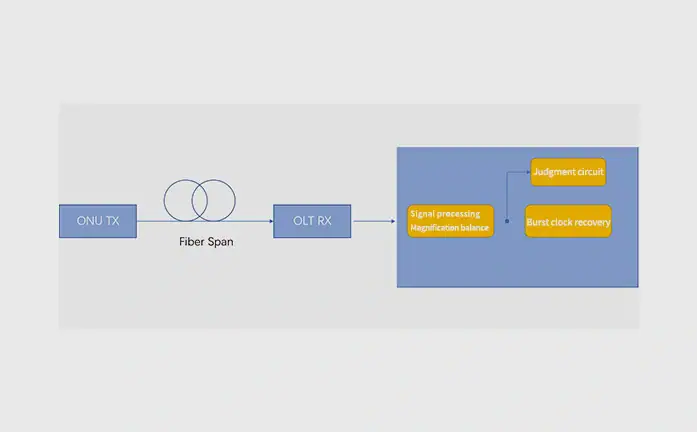
Built-in Clock Recovery, Supports for Long Fiber Testing
The built-in clock recovery allows rBT3250 to operate in a real long fiber working environment, which is basically impossible to achieve in other commonly used solutions in the industry, because those systems do not support clock recovery and cannot adapt to the impact of long fibers on latency and jitter.
TX Specification
| Type | Item | Description |
| Pattern Generator Specification | Output | Differential NRZ/PAM4 |
| Terminal | AC Coupling | |
| Output Impedance | 100 Ω ± 10% | |
| Pattern | PRBS7, 15, 23, 31, SSPR, Custom Defined Pattern and CID | |
| Burst Signal Rate (GBaud)[1] | NRZ: 12.4416/24.883/25.78125/49.7664/51.5625 PAM4: 24.8832/25.78125 |
|
| Frequency Accuracy | ±50 ppm (typical) | |
| Output Amplitude (differential) | 100-900 mVp-p (typical) [1] | |
| Rise Time [2]
(20–80%) |
<12 ps (typical) | |
| Fall Time [2]
(20–80%) |
<12 ps (typical) | |
| Random Jitter [3] | <1.2 ps (typical) | |
| Laser Enable(TXEN) | LVTTL 3.3V | |
| Reset Signal | LVTTL 3.3V, adjustable voltage level, trigger position, and width | |
| Connector | 2.4mm female, 50 Ω | |
| Trigger and Clock Specification | Clock Output Amplitude | >200 mVp-p |
| Output Type | AC Coupled, Single-ended | |
| Div Ratio (Adjustable) | 4/8/16 |
[1] 9.953/10.3125 GBaud awaiting supportr
[2] Measured with 49.7664 GBaud NRZ
[3] Tested with/after Jitter separation
RX Specification
| Type | Item | Description |
| Error Detector Specification | Input | Differential NRZ |
| Terminal | AC Coupled | |
| Input Impedance | 100 Ω ±10% | |
| Input Range (Differential) [1] | 100 ~ 900 mVp-p (typical) | |
| RSSI (Differential) [2] | 100 mVp-p (typical) | |
| Pattern | PRBS7, 15, 23, 31, CID | |
| Burst Signal Rate (GBaud) | NRZ: 12.4416/24.883/25.78125/49.7664/51.5625 PAM4: 24.8832/25.78125 |
|
| Connector | 2.4mm female, 50 Ω |
[1] Take care of output amplitude from DUT as the high voltage signal may damage the receiver
[2] If the input is below the sensitivity threshold, high bit errors or LOS may occur