
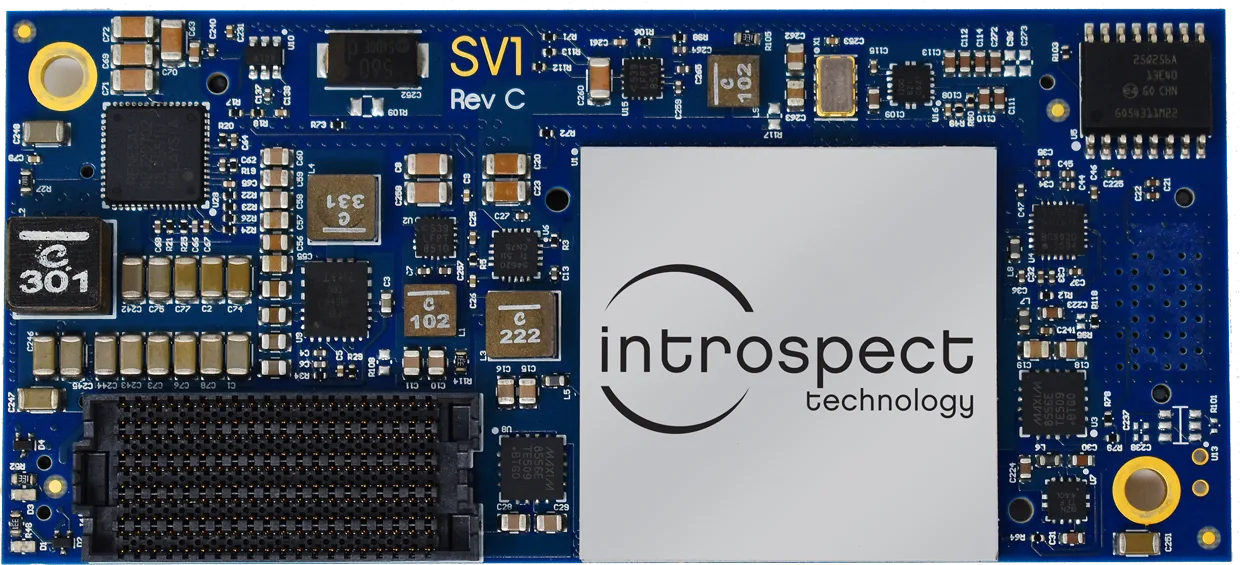
SV1D-4
The SV1D-4 Direct Attach SerDes Test Module is a compact, highly integrated tester designed for modern high-speed digital test environments. Mounted directly onto an application or test board without the need for cables, it supports fully parallel, multi-site Gbps testing—ideal for cost-effective, scalable production. The SV1D-4 supports continuous data rate selection up to 4 Gbps and includes 8 independent transmitters with configurable signal impairments such as sinusoidal and random jitter injection, TX de-emphasis, and lane-to-lane UI/sub-UI skew. A
dditionally, 8 independent receivers provide per-channel equalization, true parallel bit-error-rate (BER) measurement, and tools for efficient eye-margining analysis. This self-contained module integrates on-board power sequencers and clock synthesizers and can be fully automated via an SPI interface and optional parallel data interface—making it a robust solution for advanced SerDes interface validation with a tiny physical footprint and minimal I/O requirements.
- Multi-site, fully parallel test capability with individual pattern and BER control per lane
- Self-contained solution with on-board power sequencers and clock synthesizers
- Automated with built-in scripting capability for test time minimization
- Tiny footprint and minimal I/O requirements
The SV1D-4 Direct Attach SerDes Test Module is a highly-integrated tester that mounts directly on an application or test board without requiring cables. It satisfies the growing need for parallel, multi-site Gbps testing methodologies at the lowest possible total cost.
The SV1D-4 provides continuous data rate selection up to 4 Gbps. It features 8 independent transmitters with signal impairments including sinusoidal and random jitter injection, TX de-emphasis and lane-to-lane UI and sub-UI skew injection. It features 8 independent receivers with per-channel equalization, true parallel bit-error-rate measurement and controls for rapid eye-margining measurement. Communication with ATE is handled seamlessly via an SPI bus and via an optional parallel interface for extended data transfers.